
If you’ve experimented with AI tools for HR compliance questions, you’ve probably noticed a pattern: they sound confident, but you can’t always trust them. Ask about parental leave rules in one country and the answer is solid. Ask a slightly more nuanced question, for example, how a proposed change to a law would affect an existing policy, or how a rule differs between two similar-sounding jurisdictions, and the answer gets shaky, or flatly wrong.
That inconsistency isn’t a small bug that will get fixed with the next model upgrade. It’s a structural problem with how most AI tools are built, and it’s the reason Corbey’s AI advisor was built differently from the start.
Why generic AI tools struggle with HR compliance
Most AI assistants processing large sets of data are built on a general-purpose technique: feed the system a large pile of documents like labor laws, statutes, internal policies, and let an automated process chop them into pieces and search across them when a question comes in. It’s the fastest way to stand up an AI tool, and it works fine for simple lookups.
The problem is that HR and employment law isn’t a simple-lookup domain. It’s dense with exceptions, jurisdiction-specific terminology, and the constant question of “is this a proposed change or is this actually the law right now?” Independent research backs this up: one well-known study (called LIMIT) found that generic AI search approaches start making mistakes once a knowledge base grows past just a few dozen documents. Real HR compliance libraries are far larger than that, and the failure rate follows.
In practical terms, tools built this way tend to get compliance questions right somewhere between 40% and 60% of the time. For an HR team, that’s not a usable margin of trust. You can’t tell your team, or your leadership, “this is probably right.”
Why “just ask ChatGPT/Claude/Gemini” isn’t the same thing
It’s worth addressing directly, since it’s the comparison every HR Tech buyer eventually makes: why not just ask a general-purpose AI assistant?
General-purpose models don’t have a dedicated HR knowledge base behind them. When you ask one an HR compliance question, one of two things is happening:
- It’s answering from what it learned during training — a broad snapshot of public text, frozen at a cutoff date. That means it goes stale the moment a law changes, and its coverage is uneven: well-documented jurisdictions like the Netherlands and the UK are represented far better than smaller or less-digitized countries. The model also can’t signal when its underlying knowledge is thin — a confident-sounding answer on an obscure immigration rule and a confident-sounding answer on well-known parental leave law look identical, even though only one of them is reliable.
- It’s doing a live web search and reading whatever comes back — government portals, law firm blogs, news articles, forums, all treated the same way. There’s no built-in way to tell an official source from a third-party summary, or a pending bill from a law already in force, unless that distinction happens to be obvious from the page itself. And because nothing connects the documents it finds beyond that single search, questions that require combining a rule from one source with an exception from another are where it breaks down fastest.
Either way, the model is re-deriving the structure of employment law from scratch, on the spot, for every single question. It has no persistent, expert-built map of the domain to fall back on — which is exactly the gap Corbey’s advisor was built to close.
Corbey’s approach: automate with expertise
Corbey’s advisor was built on a simple principle: understanding how employment law and HR regulation actually work is a job for domain experts. Before any AI answered a single question, Corbey’s team did the unglamorous work of mapping the domain by hand:
- A structured map of legal topics: currently 70 distinct topics, covering 28 countries, built by people who understand HR compliance across the jurisdictions.
- A clear separation between proposed legislation and enacted law, with explicit rules for when the advisor should reference a pending bill versus the law currently in force, so an HR team can plan around what is coming and still comply with what applies today.
- Country-by-country nuance, capturing the fact that the “same” HR concept like notice periods, probation rules, leave entitlements is defined and named differently in every country, so the map keeps the local version.
- A glossary explaining to the model what are the terms used for each country and what are the interconnections between different documents on each topic / term.
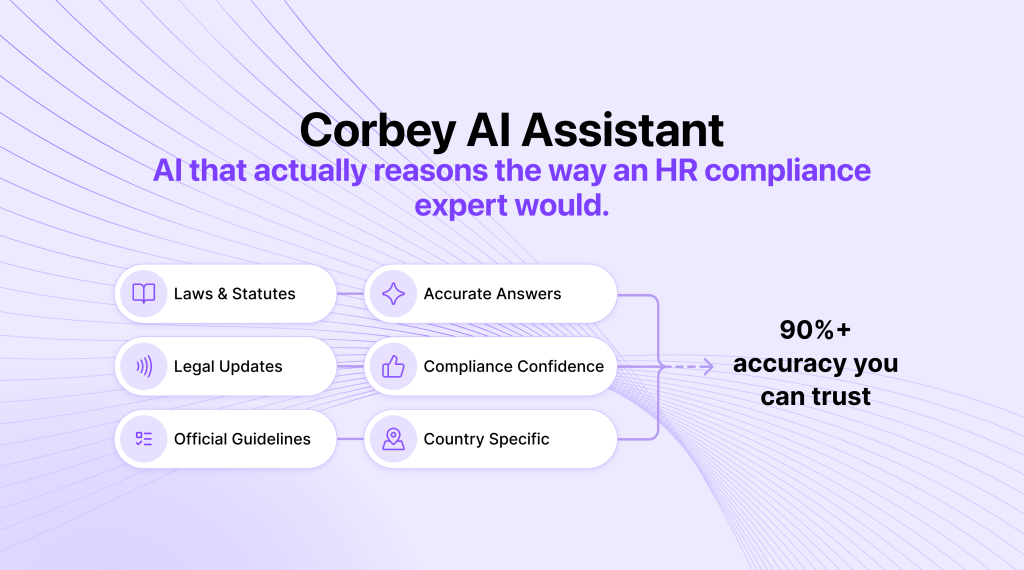
This hand-built map sits underneath everything the advisor does. It’s the difference between an AI that pattern-matches across text and an AI that actually reasons the way an HR compliance expert would.
What the advisor is actually built on
None of this works without comprehensive, current source material. Corbey’s knowledge base spans the full range of material an HR or Global Employment team actually needs to make a compliant decision:
- Laws: the enacted legislation currently in force
- Legal updates: changes as they happen, not just a periodic refresh
- Official employment guidelines: the regulatory guidance issued by government bodies alongside the law itself
- Immigration policies and regulations: visa, work permit, and cross-border employment rules
- Statistical reports by country: the benchmark data HR teams need for planning and comparison
- Tax and social contributions regulations: the payroll-adjacent rules that determine real cost and compliance obligations
The current database under the hood of Corbey AI Advisor includes 116,281 data points, and 586,896 connections, and the source base is being updated instantly.
Each of these source types gets the same treatment described above: expert-modeled, structured, and mapped into the domain rather than dumped into a generic search index. That’s what allows the advisor to answer not just “what does the law say,” but the fuller set of questions an HR Ops or Global Employment team actually has — cost implications, upcoming changes, and country-specific administrative detail included.
What happens when an answer isn’t good enough yet
Here’s the part that matters most for an HR Ops leader evaluating AI tools: what happens when the system gets something wrong?
For most AI tools, the honest answer is “we’re not entirely sure how to fix that.” The underlying process is a black box. You can retrain it, or adjust it, but there’s no guarantee it will address the specific gap you found, and it might introduce new ones.
Corbey’s advisor doesn’t have that problem, because the domain knowledge underneath it is a structured, human-curated map that can always be extended. When the team identifies a category of questions where answers fall short, there’s a concrete fix:
- Identify exactly what additional detail the Advisor needs to answer the question correctly
- Have domain experts extract and organize that detail into clean, structured reference data
- Teach the Advisor exactly when to pull from that structured data instead of guessing from raw text
In other words, quality improvement isn’t a matter of hoping a model update helps. It’s a repeatable process of expanding the expert-built map, the process that can produce reliable answers at scale.
The result: an advisor built for accuracy, not just speed
The outcome of this approach shows up directly in accuracy: where generic AI tools land in the 40–60% range on real-world compliance questions, Corbey’s advisor reaches 90%+ accuracy on the same kind of rigorous testing.
For HR Ops and HR Tech teams, that gap is the whole point. An AI advisor is only useful if you can trust its answers on the questions that actually carry risk — leave entitlements, termination rules, cross-border policy differences, upcoming legislative changes. Corbey was built specifically so that trust doesn’t have to be taken on faith. It’s the product of treating HR compliance as what it is: a domain that deserves real expertise, not just a bigger pile of documents and a faster algorithm.